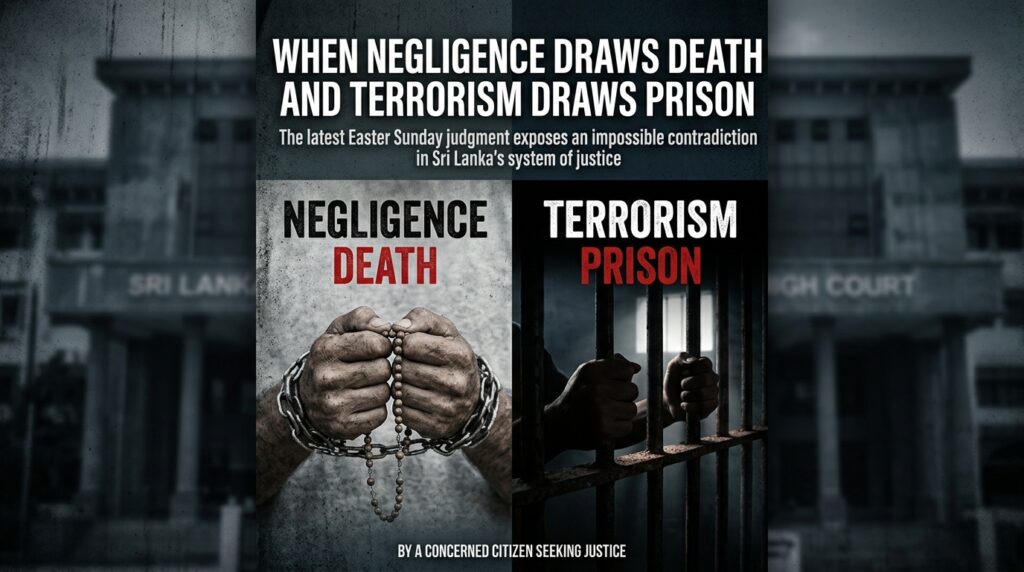
When Negligence Draws Death and Terrorism Draws Prison
The latest Easter Sunday judgment exposes an impossible contradiction in Sri Lanka’s system of justice
By a concerned citizen seeking justice
On 22 September 2026, a three-judge Permanent High Court Trial-at-Bar unanimously convicted 15 men in the main Easter Sunday terror attack case. The court found them guilty of offences connected to the conspiracy behind the attacks, aiding and abetting, promoting extremist ideology, weapons training, and maintaining training camps and safe houses. The prosecution had brought more than 23,270 charges arising from the coordinated bombings that killed 269 people and injured more than 500.
The sentences ranged from 200 to 260 years of rigorous imprisonment. One accused received 260 years, four received 240 years, five received 220 years, and five received 200 years. The court also ordered the confiscation of their movable and immovable property.
These are undeniably severe prison sentences. No one should minimise the gravity of the convictions or the suffering of the victims. But the judgment creates a question that Sri Lanka cannot avoid: how can people found guilty of intentional participation in a terrorist conspiracy receive prison terms, while two public officials who neither joined the conspiracy nor intended a single death were sentenced to death for alleged failures to prevent it?
A contradiction too serious to ignore
On 31 July 2026, former Secretary to the Ministry of Defence Hemasiri Fernando and former Inspector General of Police Pujith Jayasundara were sentenced to death in relation to the same Easter Sunday attacks. Their convictions did not rest on any finding that they planned the bombings, assisted the attackers, promoted their ideology, provided weapons, maintained safe houses, or desired that anyone should be harmed. The case against them concerned omissions: that they had received warning information and failed to take sufficient steps to prevent the attacks.
The contrast is now stark. On one side are men whom a unanimous bench found guilty beyond reasonable doubt of deliberate terrorism-related conduct. They received terms of rigorous imprisonment. On the other side are two officials convicted by a divided two-to-one bench on the basis of alleged negligence and omission. They received the ultimate punishment known to law.
This is not an argument that the 15 convicted men should have received harsher sentences. Nor is it an attempt to interfere with the independence of either court. It is a demand for coherence, proportionality, and equality before the law. A legal system loses moral authority when its punishment appears more severe for a failure to prevent intentional violence than for intentional participation in the machinery that produced it.
Negligence is not murderous intent
Criminal law has always distinguished between an intentional act and a negligent omission. That distinction is not a loophole. It is one of the foundations of justice.
The horror of the consequence cannot, by itself, supply the mental element required for murder. The State must prove not only that an accused person failed in a duty, but every legal ingredient of the offence charged, including the required intention or knowledge and the necessary causal connection, beyond reasonable doubt.
There has never been an allegation that Hemasiri Fernando or Pujith Jayasundara shared the bombers’ objective. There has never been an allegation that they communicated with the attackers, funded them, trained them, sheltered them, or knowingly helped them execute their plan. Whatever criticism may properly be directed at their decisions, the legal and moral character of an omission by a public official is fundamentally different from a deliberate agreement to assist terrorism.
If negligence was proved, it should have been punished under the law governing negligence. Transforming negligence into murder because the consequences were catastrophic does not honour the victims. It weakens the very principles that protect every citizen from punishment for a crime whose essential mental element has not been established.
A case that has never been clear or unanimous
The procedural history makes the death sentences still more troubling. In February 2022, a three-judge Trial-at-Bar acquitted both officials without calling for a defence after finding that the prosecution had failed to establish a prima facie case. The Supreme Court later directed that the trial continue and that the defence be called. After the completed trial before a differently constituted bench, the convictions and death sentences were imposed by a two-to-one majority, with one judge concluding that the accused should be acquitted.
By contrast, the latest convictions of the 15 accused were unanimous. The court expressly found the relevant charges proved beyond reasonable doubt after years of evidence concerning extremist lectures, weapons training, training camps, safe houses, and participation at different stages of the conspiracy.
A death sentence imposed in a case that began with a unanimous acquittal and ended with a divided conviction demands the most exacting scrutiny. The later unanimous terrorism convictions only sharpen that need.
Responsibility must follow actual authority and knowledge
Hemasiri Fernando was the Secretary to the Ministry of Defence. He was not the Minister of Defence, the Commander-in-Chief, or the elected authority responsible for national security policy. He had assumed office on 30 October 2018 and had served for less than six months when the attacks occurred.
The President at the time, Maithripala Sirisena, simultaneously held the offices of President, Minister of Defence, and Commander-in-Chief. The State Intelligence Service received and assessed the foreign warning. The police and intelligence agencies possessed years of institutional knowledge about Zahran Hashim and his network. The entire security structure failed, yet capital criminal liability was ultimately imposed on only two officials.
This does not mean that rank or public service should shield anyone from accountability. Fernando’s approximately three decades of public service do not place him above the law. They do, however, make it essential that liability be based on what he personally knew, the authority he lawfully possessed, the professional advice communicated to him, and the actions he could realistically take – not on the total knowledge scattered across numerous State institutions.
Justice cannot operate by symbolism
The public may be told that prison terms of 200 to 260 years are, in practice, overwhelming punishments. That is true. But the symbolic hierarchy created by these judgments remains impossible to defend. The law has reserved death for the officials convicted of omission, while reserving imprisonment for those convicted of intentional participation in the terrorist conspiracy itself.
A punishment system communicates society’s assessment of culpability. If intent, participation, preparation, and assistance attract imprisonment, while negligence attracts death, what principle is the system applying? If the answer is that the officials held senior positions, then criminal liability has been made dependent on title rather than proof of murderous intent. If the answer is the scale of the tragedy, then emotion has displaced legal classification.
Neither answer is compatible with equal justice.
The victims deserve the whole truth
Nothing about this comparison diminishes the suffering of those killed, injured, or permanently scarred on Easter Sunday. Their families deserve accountability for every person who planned, financed, enabled, concealed, obstructed, or negligently failed to act. They also deserve a justice process that distinguishes carefully between those different forms of responsibility.
The latest judgment demonstrates that the State was capable of prosecuting an extensive conspiracy case, presenting years of evidence, and securing unanimous convictions against people found to have participated in extremist and terrorism-related activity. It therefore becomes even harder to justify why two officials, with no alleged connection to the terrorists and no alleged intention to cause harm, were singled out for death.
Sri Lanka must ask whether this is justice or merely the appearance of accountability: the harshest possible sentence imposed on two visible officials while the wider political, intelligence, and institutional chain remains contested and incomplete.
The answer cannot be that one judgment must remain beyond public examination simply because it was delivered by a court. Respect for the judiciary does not require silence about inconsistency. On the contrary, the rule of law depends on judgments being open to principled scrutiny, especially where life and liberty are at stake and appellate proceedings remain available.
A legal system must make sense
The 15 convicted men were entitled to a fair trial, and the nine acquitted defendants were entitled to be released when the prosecution failed to prove the charges against them. Hemasiri Fernando and Pujith Jayasundara are entitled to the same rigorous protection of the presumption of innocence, the requirement of proof beyond reasonable doubt, and the distinction between negligence and intentional crime.
This is not a plea for privilege. It is a plea for consistency.
When intentional assistance to terrorism is punished with imprisonment but an alleged negligent failure to prevent terrorism is punished with death, the contradiction is not merely uncomfortable. It strikes at the credibility of the entire system.
The Easter Sunday victims deserve the full truth. The country deserves a complete and impartial accounting. And two men should not be condemned to death merely so that a broken system can claim it has delivered justice.