
Questionable Coal Imports Cost Sri Lanka Rs. 4.5 Billion in Additional Power Expenses
Sri Lanka’s ongoing investigation into controversial coal imports has revealed that the supply of questionable-quality coal to the Lakvijaya Coal Power Plant resulted in an additional cost of Rs. 4.517 billion during the first four months of this year.
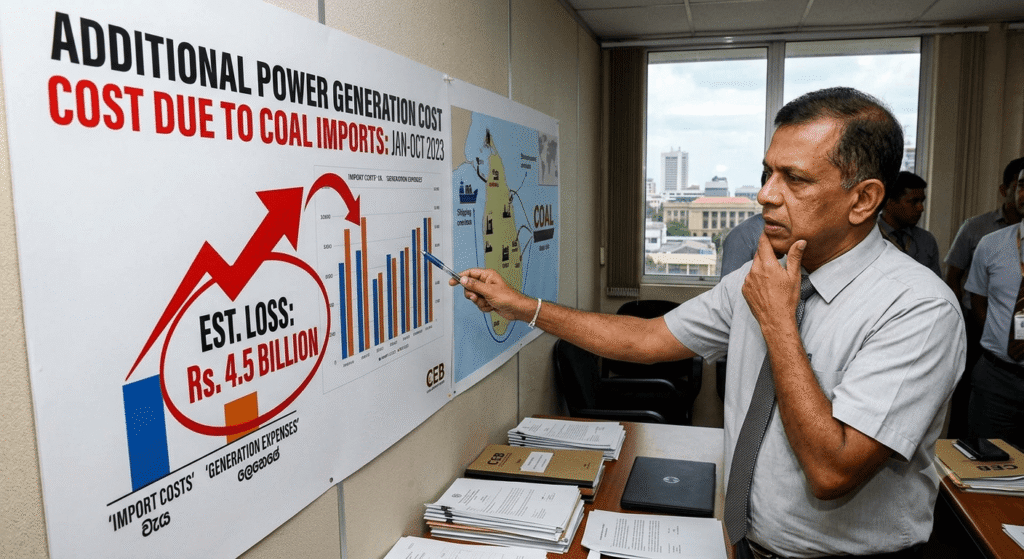
The revelation was made before the Presidential Commission of Inquiry into Coal Transactions based on evidence provided by Buddhika Sanjeewa, Director of the National System Control Centre.
According to the testimony, the additional expense was caused by lower-quality coal failing to generate the expected electricity output required by the national power grid.
As a result, authorities were forced to purchase electricity from alternative power plants to compensate for the shortfall in generation capacity.
Evidence presented before the Commission revealed that the Kerawalapitiya Sobadhanavi private power plant was among the main facilities used to bridge the electricity supply gap during the period under investigation.
Concerns Over Coal Quality Reports
The inquiry also examined concerns regarding the payment system used for coal suppliers and discrepancies between laboratory reports issued at loading ports and test results obtained after coal shipments arrived in Sri Lanka.
Professor Saliya Jayasekara, Chairman of Lanka Electricity Company (Private) Limited), informed the Commission that suppliers receive 80% of the payment based on laboratory reports issued at the port of loading.
The remaining 20% payment is released after laboratory tests are conducted once the coal is unloaded in Sri Lanka.
He stated that comparisons between loading port quality reports and tests conducted after arrival had revealed inconsistencies in several coal shipments.
According to Professor Jayasekara, coal samples are tested at multiple stages, including during loading, unloading, and through the laboratory facility located at the Lakvijaya Power Plant.
Independent Testing Conducted
Following concerns over imported coal quality, additional assessments were carried out by Bureau Veritas, an international quality inspection and certification organisation.
Professor Jayasekara told the Commission that laboratory reports generated by the facility at Lakvijaya Power Plant were found to provide the closest representation of the actual coal quality compared with other testing methods.
He further explained that financial losses occur due to imported coal having smaller particle sizes and higher ash content, which reduce efficiency and increase operational expenses.
Procurement Process Under Review
The Commission also heard evidence from Sameera Adikaram, Director of the Licensing Division of the Public Utilities Commission of Sri Lanka, regarding the regulation of additional electricity generation costs linked to disputed coal supplies.
His testimony focused on data analysis methods used to maintain uninterrupted electricity supply while managing the impact of the coal quality issues.
In addition, Prabath Indika Prasanna, Head of Policy at the National Procurement Commission, was summoned before the Commission.
The inquiry examined the appointment of committees involved in the coal procurement process and the procedures followed when making procurement-related decisions.
The Presidential Commission is continuing investigations into the coal import process, supplier payments, quality assessments, and possible financial implications arising from disputed coal shipments.
Read more articles like this on www.srilankanpost.com