Is This the Beginning of the End for Sri Lanka’s Democracy?
Democracy rarely disappears overnight. More often, it is weakened gradually—one institution, one constitutional safeguard and one carefully justified decision at a time. Sri Lanka may now be approaching such a moment.
The Cabinet has approved a proposal to increase the retirement age of judges by two years and to amend both the Constitution and the Judicature Act to give effect to it. The Government argues that the proposal will enable the courts to retain experienced and knowledgeable judges and help address delays within the judicial system.
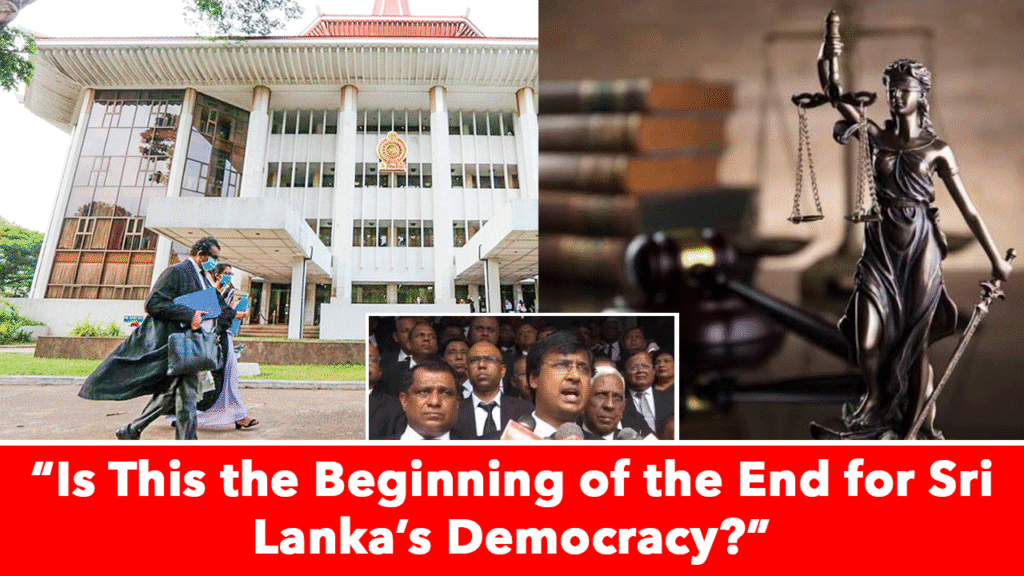
On the surface, that explanation may appear reasonable. Judicial experience is valuable, and Sri Lanka’s courts unquestionably face serious delays. But constitutional decisions cannot be judged merely by the explanation offered for them. They must also be examined in the context in which they are introduced, the individuals who stand to benefit and the effect they may have on public confidence.
That is where this proposal becomes deeply troubling.
The proposed amendment would apply immediately to judges who are already in office, including the present Chief Justice. It would therefore have the practical effect of extending the tenure of serving judges beyond the retirement dates that applied when they were appointed.
The Government has denied that the proposal is intended solely to extend the tenure of one individual. However, the question confronting the public is not simply whether the Government admits to such an intention. The question is whether a constitutional amendment of this nature creates the appearance that the rules are being rewritten to retain particular officeholders.
In a democracy, appearances matter—especially where the judiciary is concerned.
Judges must be independent not only in fact but also in the eyes of the public. Citizens must have confidence that judicial appointments, promotions and retirement dates are governed by established constitutional rules, rather than by the preferences or immediate interests of the political leadership of the day.
Once a government begins altering those rules while the affected officeholders remain in power, an unavoidable suspicion arises: is this genuinely a reform of the judicial system, or is the Constitution being tailored to achieve a predetermined result?
This concern is not limited to political opponents of the Government.
The Bar Association of Sri Lanka has raised serious concerns regarding judicial independence, the administration of justice and the rule of law. It has questioned the absence of a compelling institutional justification for changing retirement ages that have remained in place since the adoption of the 1978 Constitution. It has also called for meaningful consultation with the judiciary, the legal profession and other relevant stakeholders before any further action is taken.
The Judicial Service Association, representing District Judges and Magistrates, has also opposed increasing the retirement age. Among the consequences feared is the freezing of promotions throughout the judicial service. If senior judges remain in office for another two years, every judge waiting below them may have to wait longer for advancement. This could affect morale, career progression and the ability of the judiciary to attract and retain outstanding legal professionals.
There is also an obvious question the Government has not satisfactorily answered: if the purpose is to reduce the backlog of cases and strengthen judicial capacity, why have existing vacancies in the superior courts not been filled promptly?
At the time concerns were first raised, legal groups pointed to several vacancies in the Supreme Court and Court of Appeal. Filling duly authorised vacancies, improving court administration, investing in technology, appointing additional judicial and administrative personnel, and reforming inefficient procedures would all directly address delays.
Extending the tenure of those already holding office is not a substitute for comprehensive judicial reform.
The controversy has now attracted international attention. The Commonwealth Lawyers Association has warned against piecemeal or ad hoc constitutional amendments and emphasised that constitutional reform must be preceded by proper public and stakeholder consultation.
The French National Bar Council has also expressed its full support for the position taken by the Bar Association of Sri Lanka. It has urged the Sri Lankan authorities not to proceed with the proposed amendment and has warned of the danger it poses to public confidence in judicial independence.
These interventions should not be dismissed as foreign interference. When respected international legal organisations find it necessary to warn Sri Lanka about the independence of its judiciary, the Government should pause and reflect on the damage this proposal may cause to the country’s democratic standing.
The issue is not whether judges become less capable when they reach the ages of 63 or 65. Nor is it unreasonable for a country to reconsider retirement ages as life expectancy, professional capacity and institutional needs change.
The real issue is how, when and to whom such a change should apply.
If the Government genuinely believes that judicial retirement ages require reconsideration, it should establish an independent and transparent process. The judiciary, the Bar Association, judicial officers, constitutional experts, civil society and the public should be consulted. The reform should be supported by objective evidence and considered as part of a broader programme to improve the administration of justice.
Most importantly, any change should apply only to judges appointed after the amendment comes into force—or, at a minimum, after all judges currently holding the offices most directly affected have retired. Such a safeguard would remove the suspicion that the Constitution is being amended to benefit particular individuals.
Without that protection, the proposal cannot credibly be described as a neutral institutional reform.
Sri Lanka’s recent history should have taught us the danger of allowing temporary political convenience to override constitutional principle. Successive governments have weakened independent institutions, concentrated power and defended controversial measures as necessary responses to the problems of the moment. The result has been the gradual erosion of public trust in Parliament, the executive, law enforcement and the justice system.
The present Government came to power promising a decisive break from that political culture. It promised accountability, transparency and an end to the manipulation of public institutions for private or political purposes. Those promises created enormous public expectations.
This proposal places the Government in direct conflict with the very principles it claimed it would protect.
No government—however popular, well-intentioned or electorally powerful—should be permitted to change constitutional rules in a manner that could determine who continues to occupy the highest judicial offices. Today, such a power may be exercised in favour of an individual some citizens trust. Tomorrow, the same precedent may be used by a far less restrained administration to secure a judiciary willing to accommodate its political ambitions.
That is why this moment extends far beyond the retirement date of any single judge.
The judiciary is often the final institution standing between the citizen and the unchecked power of the State. If the public begins to believe that judicial tenure can be extended through political discretion, every future judgment involving the Government may be viewed through a cloud of suspicion. Even judges acting with complete integrity could find their independence questioned because of a constitutional change they did not initiate.
That damage may be impossible to reverse.
The Government must therefore withdraw this proposal in its present form. If reform is genuinely necessary, it must be undertaken transparently, after meaningful consultation, and without benefiting those currently holding office.
Sri Lanka’s democracy will not end with a single Cabinet decision. But democracies begin to fail when those in power discover that constitutional safeguards can be adjusted to suit the needs of the moment—and when the public becomes too tired, divided or afraid to object.
At moments such as this, silence is not neutrality. A warning commonly attributed to Edmund Burke remains painfully relevant: “The only thing necessary for the triumph of evil is for good men to do nothing.”
This is therefore a moment for lawyers, judges, academics, civil society leaders, religious leaders, journalists and every citizen who values democracy to speak. The defence of judicial independence cannot be left to the legal profession alone. Once the independence of the courts is compromised—or even reasonably perceived to have been compromised—the rights and freedoms of every Sri Lankan are placed at risk.
This may not yet be the end of Sri Lankan democracy.
But if good people remain silent while constitutional safeguards are altered to serve the interests of the moment, it could become the beginning of the end.
Read more on – srilankanpost.com