Sri Lanka to Tax Cryptocurrency Income as ‘Other Income’, Deputy Finance Minister Says
Income earned through cryptocurrency transactions and related activities in Sri Lanka will be treated as “other income” by the Inland Revenue Department, despite cryptocurrencies not being recognised as legal tender in the country.
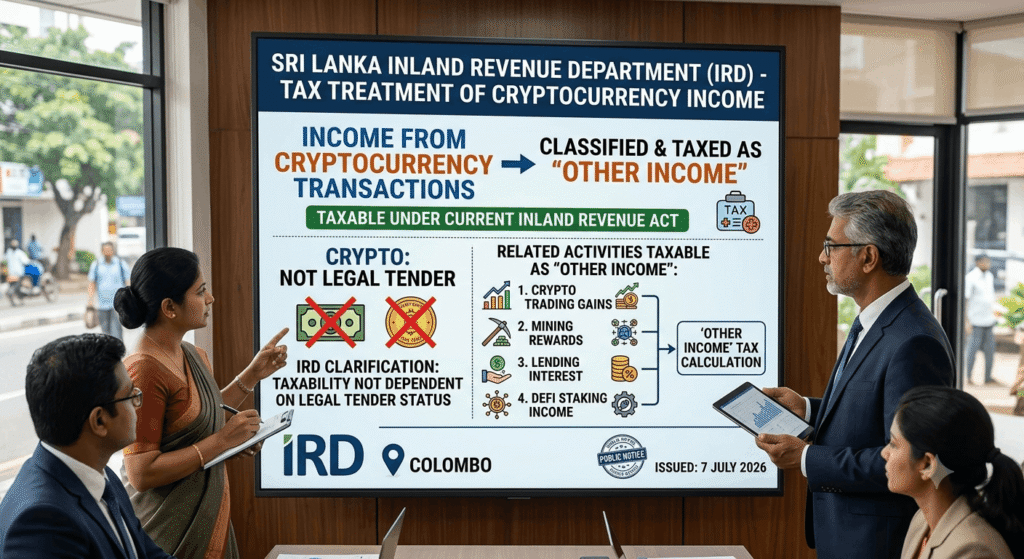
Speaking in Parliament today (July 9), Deputy Minister of Finance and Planning Anil Jayantha Fernando made the clarification while responding to questions raised by Ravi Karunanayake.
The Deputy Minister stated that under the Central Bank of Sri Lanka Act, No. 16 of 2023, the Sri Lankan Rupee remains the country’s only legal tender, while cryptocurrencies and other virtual or digital assets are not recognised as an official means of payment.
He further explained that cryptocurrencies are not regulated as an asset class or financial instrument in Sri Lanka. As a result, the Central Bank of Sri Lanka has not licensed or authorised any cryptocurrency exchanges, digital asset trading platforms, mining operations, or related service providers to operate within the country.
According to the Deputy Minister, cryptocurrency trading activities are not integrated into Sri Lanka’s regulated financial system. Since no domestic regulatory authority supervises digital asset platforms, individuals who invest or trade in cryptocurrencies do so entirely at their own risk.
He also noted that the Central Bank has consistently informed the public since 2018 that cryptocurrencies are not recognised as legal tender in Sri Lanka.
In addition, the Deputy Minister confirmed that the country’s existing laws do not recognise cryptocurrency or virtual asset investments as regulated financial instruments. He added that holders of residence cards in Sri Lanka are prohibited from making foreign exchange payments for virtual currency transactions.
He emphasised that, under the current legal and regulatory framework, Sri Lanka’s formal banking and financial system cannot be used to facilitate cryptocurrency-related transactions, even though profits earned from such activities remain subject to taxation under the Inland Revenue Department.
Read more articles like this on www.srilankanpost.com