Two Men Sentenced to Death, a Nation Still Denied the Truth
On 31 July 2026, former Secretary to the Ministry of Defence Hemasiri Fernando and former Inspector General of Police Pujith Jayasundara were sentenced to death for failing to prevent the Easter Sunday terrorist attacks of 21 April 2019.
The verdict produced the headlines one would expect. Two former senior officials had been convicted, and a nation still carrying the wounds of one of its darkest days was offered the appearance of accountability and closure.
But was Sri Lanka finally given justice—or merely a verdict?
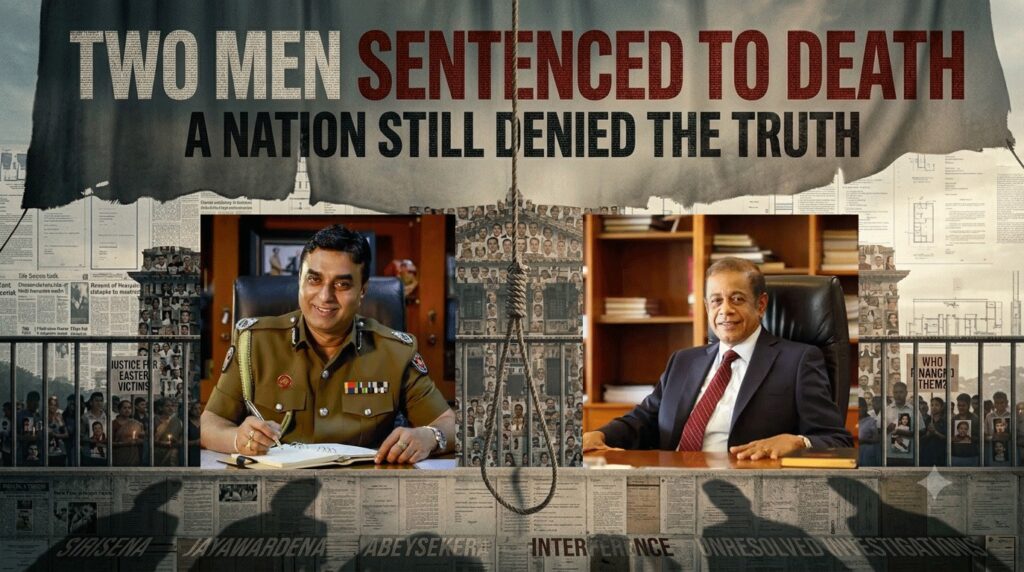
The attacks did not arise from the failures of two men alone. They followed years of known extremist activity, unexecuted arrest warrants, interrupted investigations, alleged political interference, institutional breakdown and failures extending across the highest levels of political leadership, intelligence and law enforcement. Yet only Fernando and Jayasundara were prosecuted for murder and ultimately condemned to death.
The Government did not write the judgment. Its responsibility lies instead in whether it pursued the complete chain of accountability or allowed the criminal process to remain selectively confined. The evidence points particularly to four figures—President Maithripala Sirisena, SIS Director Nilantha Jayawardena, Senior DIG CID Ravi Seneviratne and CID Director Shani Abeysekera—whose political authority, control of intelligence or accumulated investigative knowledge placed them in positions of greater institutional culpability. Yet none faced the capital prosecution or punishment imposed on Fernando and Jayasundara.
The chronology set out below is not based merely on Fernando’s untested recollection. It is drawn from court documents, contemporaneous records and evidence examined through witness testimony and cross-examination during the trial. It must therefore be considered as part of the established evidentiary record against which the verdict should be judged.
Accountability is not the same as murder
There is no dispute that intelligence warnings existed before the attacks or that Sri Lanka’s national-security system failed catastrophically. That failure cost hundreds of innocent lives and demands accountability.
But criminal liability must be distinguished from political, administrative, institutional and moral responsibility. Murder is not established merely because the consequences of an omission were horrific. The prosecution must prove every element of the offence, including the required guilty mind, beyond reasonable doubt.
Sri Lanka’s Penal Code recognises the distinction between causing death through a rash or negligent act and murder, which requires intention or a legally sufficient degree of knowledge. Did Fernando or Jayasundara intend anyone to die? Did either intend to assist the bombers? Did they possess verified, specific and actionable intelligence establishing that death would occur in all probability? If what was proved was negligence or dereliction of duty, however serious, how was the mental element necessary for murder established?
These questions are particularly important because the procedural history was far from straightforward. In February 2022, a three-judge Trial-at-Bar acquitted both men without calling for a defence, finding that the prosecution had failed to establish a prima facie case. The Supreme Court later directed that the trial continue. Even after the completed trial, the convictions were imposed by a two-to-one majority, with one judge concluding that the accused should be acquitted.
This was not an uncomplicated case in which guilt was obvious. The death penalty should never become a substitute for proving the legal ingredients of murder.
A public servant who inherited a fractured system
Fernando was not an all-powerful political ‘Defence Secretary’ of the kind familiar from the United States. His office was Secretary to the Ministry of Defence—the Ministry’s senior administrative official. He was not Minister of Defence, Commander-in-Chief or an elected authority responsible for national-security policy. Those powers rested with President Maithripala Sirisena, who was simultaneously President, Minister of Defence and Commander-in-Chief.
Fernando assumed office on 30 October 2018, less than six months before the attacks. By then Zahran Hashim and his extremist network had been active for years. The SIS, CID, TID and other security officials had accumulated extensive knowledge concerning Zahran, his speeches, violence, associates and outstanding arrest warrants. That history and the depth of the investigations were never comprehensively presented to Fernando.
The security structure he inherited had also been fractured by Sirisena. The President excluded Prime Minister Ranil Wickremesinghe, State Minister of Defence Ruwan Wijewardene and IGP Jayasundara from National Security Council meetings after the 2018 constitutional crisis. Fernando objected, but Sirisena instructed him not to invite them.
The Intelligence Review Meeting was different: an operational forum at which the heads of the armed forces, Police and intelligence agencies shared and assessed current intelligence. Fernando chaired it in the State Minister’s absence. The first presentation was customarily made by SIS Director Nilantha Jayawardena, who managed the intelligence network and communicated directly and regularly with Sirisena.
What happened to the April warning?
Jayawardena received the initial foreign intelligence concerning a possible attack on 4 April 2019. It was not included in the SIS weekly report sent to Fernando. Fernando first saw the information on 8 April, when Chief of National Intelligence Sisira Mendis brought it to his office under the heading ‘An Alleged Plan of Attack.’
Although the description indicated that the information was unconfirmed, Fernando instructed Mendis to place it on the agenda for the Intelligence Review Meeting on 9 April and to tell Jayawardena to address it in his opening presentation. Jayawardena did not do so. Fernando then raised the warning with him and directed Mendis to submit it immediately and in writing to the IGP. Jayawardena also sent a report, but his assessment stated that local observations had not confirmed preparations for such an attack. The SIS’s conduct in granting the President security clearance to attend a political event in Batticaloa on 12th April is consistent with the position that it did not regard the information as a verified and imminent threat.
Jayawardena promised further investigation and a confidential follow-up report. No such report reached Fernando. This chronology is difficult to reconcile with the simplified claim that Fernando received verified intelligence and did nothing. He directed that the matter be discussed, raised it when the intelligence chief did not, and ordered that it be communicated to the IGP. The professional assessment reaching the IGP simultaneously said the information remained unconfirmed.
The position remained similar after a motorcycle explosion near Kattankudy on 16 April. Nothing communicated to Fernando identified it as a rehearsal or linked it to the earlier warning. Jayawardena issued three confidential reports concerning that explosion on 18, 19 and 20 April. They were sent to the IGP and copied to the Senior DIG overseeing the CID—but not to Fernando.
The critical conversation on 20th April
Around 4.50 p.m. on 20th April Jayawardena sent Fernando a Whatsapp message stating he had received information that Zahran Hashim’s group was planning a suicide attack which was imminent. As he was feeling unwell, Fernando didn’t see the message until Jayawardena called him about an hour later and asked him about it. It was only then that he sent an acknowledgement: “Well-received”.
The two proceeded to discuss the matter over the phone. Fernando immediately asked how reliable the information was. Jayawardena said that while the source was reliable, the SIS would contact the foreign counterpart to ascertain the truth of the situation.
Fernando immediately called the IGP, who confirmed that he had begun acting and distributing the warning among senior Police officers. Fernando instructed him to continue taking every available step in coordination with Jayawardena and similarly told Jayawardena to report any further development. Neither contacted him again that night.
That sequence may be examined for possible negligence or errors of judgment. But it raises a fundamentally different question: how did a man who sought the professional assessment, immediately contacted the IGP, confirmed Police action and instructed both responsible professionals to continue their work, come to possess the guilty mind required for murder?
Four more culpable figures remained outside the dock
The Supreme Court’s 2023 fundamental-rights judgment found that Jayawardena had failed to send the 4 April intelligence directly to Fernando and had not adequately disclosed it at the 9 April meeting. Investigations also revealed that Jayawardena had deleted data from his mobile phone and laptop before handing them over to the Presidential Commission. The judgement described his conduct as involving ‘unpardonable lapses,’ ordered him to pay Rs.75 million personally and directed disciplinary proceedings. He was later dismissed from service.
The Presidential Commission found grounds to conclude that Sirisena may bear criminal liability for his acts and omissions and recommended that the Attorney General consider criminal proceedings. The Supreme Court imposed the largest compensation order—Rs.100 million—on Sirisena. Yet neither Sirisena nor Jayawardena faced a murder indictment.
The contrast is stark. Sirisena held the political and constitutional authority over national security. He left Sri Lanka on 16 April without appointing an acting Minister of Defence. Under Sri Lanka’s constitutional and statutory framework, the authority to proclaim an emergency, call out the armed forces and impose restrictions under emergency law rested with the President and Minister—not with the Ministry’s administrative Secretary.
Jayawardena was the intelligence chief who received, assessed and controlled the critical information. Seneviratne and Abeysekera led the CID, which possessed years of investigative knowledge arising from incidents later connected to Zahran’s network. Fernando was the recently appointed public servant to whom the warning was initially withheld and repeatedly characterised as unverified. On the institutional evidence, Sirisena, Jayawardena, Seneviratne and Abeysekera each had greater authority, specialised knowledge or investigative responsibility. Yet all four escaped the murder prosecution and punishment imposed on Fernando and Jayasundara.
The unanswered CID questions
The unanswered questions extend beyond Sirisena and Jayawardena to the CID leadership. Ravi Seneviratne was the Senior DIG overseeing the CID, while Shani Abeysekera was its Director. Before Easter Sunday, their department controlled investigations capable of exposing Zahran’s network, including the Mawanella Buddha-statue attacks, the murders of two Police officers at Vavunathivu and the Wanathavilluwa explosives cache.
In January 2019, the CID recovered approximately 100 kilograms of explosives, 100 detonators, firearms, ammunition and other equipment at a suspected extremist training camp in Wanathavilluwa. Four men were arrested. Two brothers were released just days before Easter Sunday.
Evidence before the Presidential Commission indicated that Muslim Council President N.M. Ameen contacted then Western Province Governor Azath Salley regarding the suspects and that Salley intervened. Their release followed documentation placed before and signed by Sirisena. The investigating officer later described the release as a mistake and alleged pressure from senior CID officials, including Director Abeysekera, to conclude that part of the inquiry quickly.
The institutional culpability of Seneviratne and Abeysekera required the same rigorous scrutiny applied to Fernando and Jayasundara. The confidential reports concerning the 16 April motorcycle explosion were copied to the senior CID leadership. What assessment followed? Why were the connections among Mawanella, Wanathavilluwa, Vavunathivu and Zahran established only after the attacks? Despite their accumulated knowledge and investigative responsibility, neither CID leader faced punishment for failing to expose the network before Easter Sunday.
The TID’s earlier pursuit of Zahran also demands further examination. Its Director, DIG Nalaka de Silva, obtained an open warrant and Interpol Blue Notice for Zahran. He was then arrested in October 2018 over an alleged assassination plot against Sirisena and Gotabaya Rajapaksa, disrupting the investigation. In December 2023 he was discharged after the Attorney General said there was insufficient evidence to proceed.
The national failure plainly did not begin on 4 April 2019. Why, then, did capital criminal liability ultimately stop with only two men?
Justice—or a politically convenient conclusion?
President Anura Kumara Dissanayake and the National People’s Power movement came to office promising to end impunity and hold the powerful accountable. The Easter Sunday attacks became a defining test of that promise.
The prosecution of Fernando and Jayasundara began before the present Government. But once in office, the Government had the mandate and authority to pursue every recommendation and every unresolved avenue of investigation. It could have explained why equivalent criminal proceedings were not brought against the former President and former SIS Director and examined the pre-attack conduct of every intelligence and investigative institution with equal vigour.
Instead, the inherited process produced a politically dramatic conclusion: two convictions, two death sentences and headlines announcing accountability. Sirisena, Jayawardena, Seneviratne and Abeysekera—four figures who possessed greater political power, intelligence control or investigative knowledge—remained outside the murder dock. Seneviratne and Abeysekera now hold influential positions under the Government that promised to uncover the truth.
The victims and their families deserve more than symbolic punishment. They deserve to know who planned and financed the attacks, who facilitated them, whether political influence obstructed earlier investigations, why Zahran repeatedly evaded arrest and whether anyone knowingly permitted the plot to proceed.
If Fernando and Jayasundara were negligent, they should have been judged under the law applicable to the offence proved. But negligence must not be transformed into murder because the consequences were unbearable and the public demanded punishment. Nor should two convictions be used to conceal a much wider institutional and political collapse.
Two men may have been sentenced to death. Sri Lanka is still waiting for the truth.